Doing Things That Change You

DiamondsFeature

“Diamonds in the Snow” original mosaic by Christopher Warren Elam (see note below)

“…in most traditions, faith [is] not about belief but about practice. Religion is not about accepting twenty impossible propositions before breakfast, but about doing things that change you. It is a moral aesthetic, an ethical alchemy. If you behave a certain way, you will be transformed. The myths and laws of religion are not true because they conform to some metaphysical, scientific, or historical reality but because they are life enhancing. They tell you how human nature functions, but you will not discover their truth unless you apply these myths and doctrines to your own life and put them into practice. The myths of the hero, for example, are not meant to give us historical information about Prometheus or Achilles – or for that matter, about Jesus or Buddha. Their purpose is to compel us to act in such a way that we bring about our own heroic potential.”

  — The Spiral Staircase, Karen Armstrong

On the tree-lined, windy road between our home and Bloomington, I replayed this section from Karen Armstrong’s memoir, The Spiral Staircase. The next day I typed up the passage and posted it on my bedroom wall. It resonated strongly with my own ideas about religion, and captured some of the motivation behind calling our community an interfaith Catholic Worker.

Over the past two years David has been leading the way down a curious path. Like freshmen do in college, he began again to ask the big questions: Is there a God? What about miracles? What is the origin of the universe? In other words, he was taking time to intentionally examine the supernatural beliefs handed down to him. The questions had been there a long time, but he finally got around to looking them in the eye.

To be honest, when he started asking those questions, I could see little point in taking time to answer them. Why bother when there are no objective answers? Even if there were, I would still believe in the Catholic Worker way of life. I had lived its truth, and felt the abundance, love, and struggle that led to wholeness. That’s why I liked what Karen Armstrong wrote. It was by enacting values that I have been changed, not by a belief in a literal resurrection or incarnation or deified God.

David may be a secular humanist or a religious naturalist or a non-theistic Christian – or some combination of all of those things. I may be a Jesus-follower, God-Is-Love, Catholic Worker. We’re different so we understand the world in different ways. And that’s okay. From our diverse theological beliefs we still come to the same place, a place that is well represented by the Catholic Worker movement, with its focus on radical collective action and social justice.

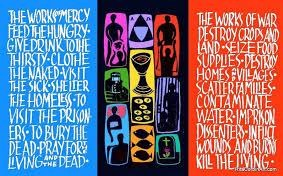
works of mercy 2

The Works of Mercy and The Works of War

Despite its name, the Catholic Worker movement is not part of the institutional Catholic Church. It is full of people who hold a variety of religious beliefs and practices. Some Catholic Worker communities are composed of Catholic members and some are not. The founders, Dorothy Day and Peter Maurin, were Catholics who discovered in the gospels and the social encyclicals of the Catholic Church instructions for how to live out their faith. They followed those instructions, particularly the Sermon on the Mount and the Works of Mercy, and started a movement that had a three-part program: round table discussions, the establishment of Houses of Hospitality to feed and shelter the poor, and farming communes to create an alternative to industrial, capitalist society.

Perhaps it is more confusing to be an ‘interfaith Catholic Worker,’ but our hope is to communicate our welcoming of diverse religious and theological beliefs and also name the way of life and the values that unite us. It’s helpful that the Catholic Worker movement already tends to emphasize practice rather than adherence to theological belief. As a decentralized movement with anarchist roots, it is a better example of orthopraxis than orthodoxy. Telling Catholic Workers what to believe will be met with resistance. But telling them what to do (feed the hungry, shelter the homeless, love your enemies, care for creation, resist violence and work for peace) will unite them in action. Whatever theological, religious or supernatural beliefs people hold, our hope is that we will be unified by the intentional way we live together at Common Home Farm. We don’t pretend it will easy to find language and rituals that resonate with diverse beliefs, but we think it is important to try.

A note about my own beliefs:

I was raised Catholic but wandered out of the Church while in college. I never found another spiritual home so I stayed out of religion for the next ten years.  When I moved into the Bloomington Catholic Worker, I saw a lived expression of Christianity that helped me become a truer version of myself. I call myself Christian because my path towards transformation has been primarily guided by people from the Christian tradition — Jesus, Dorothy Day, Peter Maurin and all the ordinary radicals in the Catholic Worker and intentional communities movement. I remain a Christian because the practices articulated in the gospels, and in the Sermon on the Mount in particular, have proven to lead to wholeness. They are not easy, but they are not harder than what modern society demands of people. And they are deeply satisfying.

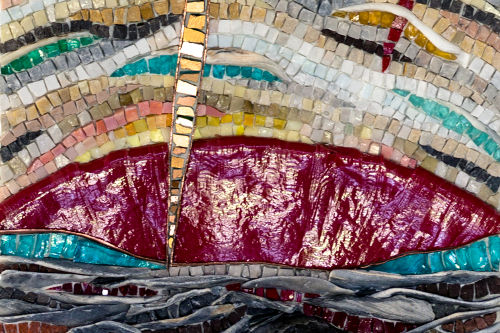
CloudFeature

“The Cloud of Unknowing” original mosaic by Christopher Warren Elam (see note below)

I am still figuring out what my relationships is with Christian myth. The resurrection has a lot of meaning and symbolic power for me. But it does not matter to me whether or not it actually, literally happened. The same is true for most supernatural stories from the Bible. As for God, I believe in God but not the father-almighty-creator-of-heaven-and-earth. What I believe in is God as love. Not God as supreme being, but rather God as “The Spirit” or “The Mystery,” the nameless presence of a loving power. Nancy Ellen Abrams, in A God That Could Be Real, proposes that God emerges from our collective aspirations. In other words, all our hopes, ambitions, and dreams give rise to an emergent phenomenon we might call God. We create God rather than God creating us.

On good nights, I light a candle and pray before bed. I read an evening liturgy from Prayers for a Planetary Pilgrim, not because I think God will answer my prayers, but because reflecting on my day grounds me in gratitude and concern for others. Sleep comes more easily after I take time to put my mind and heart to rest.

My spirituality is changing, growing and deepening. I suspect it always will be. I desire to be in a community that values and supports the work of the soul and the spirit. For it is through life with others that my spirit is fed.

P.S. A big shout out to Chris Elam, my former community mate and dear friend, for letting me use these images of his beautiful, spirit-filled artwork. The images here don’t show the entire mosaics. Please visit his website to see more of his work at www.omosaico.com.

Embracing Enmity

“Conflict is woven into the fabric of all life; opposition is normal. Reasonable creatures disagree with each other all the time…Do not be surprised when you encounter resistance. Meet it with grace and skill.” — Frank Rivers The Way of the Owl: Succeeding with Integrity in a Conflicted World 

On this journey, I frequently hear two voices in my head. One says, “Don’t wait for others. Make the decisions you want to make. Move ahead and make this thing happen!” The other says, “Slow down. Listen to the people around you. Include them wholeheartedly in the process.” 

The problem with going ahead by ourselves is that we won’t have others along with us. The problem with having others along with us is that we’ll have others along with us. It’s a question of which difficulties you prefer. I’m a community-oriented person so I tend to prefer the difficulties that come from having others along with us, namely interpersonal conflict.

conflict-clipart-person-9Undoubtedly, the hardest part of living closely with others is dealing with conflict. The question is not will there be conflict but when will there be conflict and how can it be handled well. Most conflict is small, arising out of miscommunication or misunderstanding. Working on the small conflicts helps us grow into people who can navigate relationships with grace. Some interpersonal conflict can be damaging and cause relationships to weaken. However, if all parties involved have the willingness and humility to pursue a resolution, conflict can also bring about great growth and ultimately bring people closer together.

Because conflict occurs in all relationships – whether with friends, children, spouses or siblings – it is wise to find a healthy way to address it. We had some techniques for dealing with conflict at the Bloomington Catholic Worker. We made time each week to gather and name any grievances, to confess any wrongdoing, and to reconcile with one another. When the “nip it in the bud” approach wasn’t enough, we would have a mediator facilitate a conversation between the people in conflict. We tried to take time to examine our own thoughts, feelings, and ways in which we contributed to the conflict. All these things helped to some degree but we knew that conflict would never disappear from community altogether. We could only hope to get better at handling it.

In The Way of the Owl, Rivers offers this suggestion for approaching conflict:

owl-clipart-black-and-white-bTyEyyarc“Give your opponent’s argument some place to go by acknowledging it, especially if you disagree. Instead of countering his outrageous arguments, give them some credit. Illuminate your adversary’s path with acceptance, inquiry, and even encouragement. This will disarm him, leaving him slack-jawed and flat-footed, wondering what happened to the resistance he expected.”


I have been the adversary before, making my point incessantly, fueled by emotion and self-righteousness. Let’s say it’s an argument with David, my husband, about the dishes.

“You never do the dishes when you’re home with the kids,” I say when I come home from work.

“But I vacuumed and took out the trash,” he says.

“But the dishes. I can’t stand to come home to a sink full of dirty dishes,” I say.

And then suddenly, David (who is a better person than I am), from some peaceful place in his soul, manages to say, “You’re right. I didn’t wash the dishes today.”

“But…” is on the tip of my tongue ready to be launched, but now I can’t launch it. What did he just say? I have nothing to argue about anymore. Because he agreed with me, I suddenly feel like a jerk. I have no reason to pick on a husband who vacuumed and took out the trash all the while watching two energetic kids!

It’s incredibly hard to acknowledge an adversary’s point and to really get on their side, even if that adversary is your spouse. But the result of doing so could mean more than an end to the argument but also a substantial change in your relationship. Imagine doing this with someone at work, in your family, or at church.

Imagine doing what River’s suggests here: “You must get inside his skin, feel his sensations, think his thoughts, and dream his dreams. In this way, a curious bond develops; you may actually begin to identify with your opponent and his predicament…Severe enmity can lead to bonding, even friendship and alliance.”

What is required to do this is a putting aside of one’s own ego, one’s own argument. It is another version of the Christian teaching to love your enemy. That is the hardest work that is done in community, the work that has much to teach us about ourselves and others. Had I put myself in David’s shoes, I would have come home from work full of praise and gratitude to him for caring for our kids all day. And then I would have happily started in on the dishes.

Another approach to conflict resolution is offered by Thich Nhat Han. His community, Plum Village, uses a Peace Treaty to handle conflict. The Peace Treaty is signed by members of the community after much discussion and contemplation. It outlines the steps that both people in a conflict should take once a conflict has been named. It includes many reflective, meditative practices that essentially boil down to finding humility for our part in a conflict and compassion for the other person. We never used this Peace Treaty at the BCW, but I know it will be necessary to have a conflict resolution process that is well-articulated and agreed upon by all members of the community.

I learn a lot about myself and other people through navigating conflict. Conflict is always painful – sometimes the pain proves beneficial and sometimes it just hurts. I am not looking forward to future conflicts that will arise out of the creation of Common Home Farm, but I am preparing for them the best I can.


The Daily Grind

“Most of us, male or female, work at full-time jobs that seem organized around a presumption that some wifely person is at home picking up the slack— filling the gap between school and workday’s end, doing errands only possible during business hours, meeting the expectation that we are hungry when we get home— but in fact June Cleaver has left the premises. Her income was needed to cover the mortgage and health insurance….In fact that gal Friday is us, both moms and dads running on overdrive, smashing the caretaking duties into small spaces between job and carpool and bedtime.”

— Barbara Kingsolver Animal, Vegetable, Miracle

At our daughter’s parent-teacher conference this week, I described her behavior at home: whining, fighting, sticking out her tongue, nasty under-the-breath comments, arms crossed, brow furrowed. She’s angry about everything. My behavior at home has also been marked by anger, shouting, crying, and muttering under my breath — I hate my life! I don’t hate my life, but boy is my family having a rough time adjusting to “the daily grind.” It has us bickering at breakfast and dinner (which is all the time we spend with each other now), rushing through bedtime routines to get exhausted children to sleep so we won’t hate each other so much the next day.

'Ahh...I see your future. Get up, go to work, go to bed. Get up, go to work, go to bed. Get...'

It blows my mind that most people in this country participate in the daily grind. No wonder we are an insane society! At the Bloomington Catholic Worker, we were busy but still we had more time with our children, more time for ourselves, and more time for serving others. I still struggled to parent my children well, but our daily lives generally felt more balanced. And I never ever uttered the words, “I hate my life.”

The question “Why?” comes to mind when I think about the daily grind. Why do we send our kids to school and rush off to work and then rejoin for dinner (often unpleasant), only to do it all again the next day? Yes, some people are pursuing fulfilling jobs and living out their passions. But even with the most fulfilling jobs, the daily grind asks so much of our lives. Never enough time with our families, never enough time for exercise or leisure or personal growth or other aspirations we’ve tucked away for retirement.

The answer is complex but largely wrapped up in security and stability. The daily grind, full-time work and full-time school, is how people afford housing and save for retirement and the kids’ college. It’s how we have to live to make ends meet. It’s very reasonable and responsible, but the outcome is so wretched. (Or maybe it’s just wretched for me and my family at this point in time….maybe it will get better?)

What does all this have to do with Common Home Farm? Part of our motivation for starting an intentional community farm is because we want a daily rhythm that is life-giving and balanced most of the time. We want to spend our days with our children (and with other people) engaged in meaningful, productive work. We are taking a risk in eschewing careers in favor of community. That risk is to let go of, or at least loosen our grip on the security of money.

This week I’ve been wondering if we are making the right choice. A friend of mine has community-minded parents who traveled the world seeking community instead of careers. Now they have no retirement funds and receive almost no social security payments. My friend and her husband work hard at full-time jobs to help support her parents. Her parents don’t have any other choice but to live with their children, which has been both a gift and a challenge. It makes me wonder if I should be less idealistic and more pragmatic. Should just stop my whining, find a career and start saving?

It seems to me that two truths are at play:

  1. We should work really hard now so that we can rest later.
  2. We should live out our values to the best of our ability each day.

I don’t think these should conflict with each other. I know we really want to do both: we want to work really hard to live out our values each day. I don’t know, however, that David and I will be able to rest when we are older. I don’t know that we will have any money in our bank account. I don’t know if we will be a burden on our children. I take some solace in thinking that we may have security on the land. That the place we hope to create – Common Home Farm – could be home to us and others for the rest of our lives. That the people who come to Common Home Farm, and the relationships we form, will be there to lift us up when we need help. We will have to work hard everyday to create this kind of security, but we believe it will offer us a daily rhythm instead of the daily grind.

The Economy of Interdependence

“It will become increasingly important, then, that we find ways to deconstruct the dominance of individualism in our society and to replace individualism with broader ideas of community. This shift will necessarily challenge notions of the centrality of competition for goods and the accumulation of individual wealth as we create persistent images of community well-being in our neighborhoods and reservations, in our cities, in our continental whole.” — Tink Tinker in American Indian Liberation: A Theology of Sovereignty

Lately I’ve been mourning our exit from intentional community’s economy of interdependence. I turn weepy when I realize that I have personally bought every item in our refrigerator. It’s not stuffed with the donated food from Lucky’s Market or ham bones that Anne Jones dropped by. Extra produce no longer appears randomly on our kitchen table. Instead of living off the waste of the food system (and bulk lentils and rice), I join the rest of America and go to the store to buy my food.

IMG_6588

My refrigerator contents, folks. I bought all that food! Come eat with us sometime!

One of the reasons I’m passionate about intentional community is because it decreases our dependency on money and the capitalist economy. It is a clustering of human and physical resources that are exchanged through personal relationship. At the Bloomington Catholic Worker, I didn’t need to own a second vehicle. I could borrow Chris and Emily’s van for carpooling needs, and they could take our car when they needed a more fuel-efficient vehicle. The four families in the community shared one truck (and lent it out to others) to haul manure for the gardens. We watched each other’s children for date-nights, doctor appointments, and other last minute emergencies. And together we were able to share our homes with people who had nowhere to live.

Our monthly contribution to the community (around $850), covered all our living expenses, the majority of our food expenses, and property maintenance. The community fund that paid for it all was composed of monthly contributions from members as well as some regular donations from people who supported our work. Our low living expenses were also greatly facilitated by an initial $100,000 donation that allowed for the purchase of the first two homes and no-interest loans that bought the second two homes.

What this decreased dependency on money meant is that we owned more of our time. With this time we lived out our values – volunteering in the jail, housing the homeless, welcoming visitors, planting trees and flowers, planning neighborhood block parties, taking care of our children, our neighbors and one another.

In our world, it seems that only the wealthy own their time, with no need to exchange labor for money. But the other way to own your time is to pool your resources and live simply together.

Out here in the capitalist economy of independence, I have to do more for myself by myself, which generally means I have to buy things or hire people to help solve my problems. When we moved, our living expenses increased so I took on a new job. But the new job required access to a vehicle, so we bought a second car, which also increased our living expenses. We are still trying to live out our communitarian values (carpool anyone?), even as it becomes more difficult to do so.

When we look ahead to buying land, we know we’ll have to do it in the economy of interdependence. We spent nine years at the Bloomington Catholic Worker on a path of downward mobility, intentionally avoiding the accrual of wealth. The house we lived in was a community house, and so we have no major assets. No bank will give us a mortgage because we earn below the poverty line. But that’s okay. We don’t want a large debt that would require us to find full-time paid work because that would take us away from the work at Common Home Farm.

We will need your help and your generosity. The financial stability and viability of Common Home Farm depends upon donations and no-interest loans for the purchase of the land. After that initial investment, our part-time paid work will be enough to fund the day-to-day operations. We’re hopeful that friends and family with financial resources will make an investment in the economy of interdependence we will create. Please think about what you can offer, and know that we will offer abundance back to you and the rest of the world.


The Dominoes of Discernment

“Intelligent risk taking…means entering with no illusions and knowing that your endeavors will always be attended by the conflict between the voices of despair and faith, whose concussive debate will pit your soul against your mind in a boxing ring. It means knowing you must follow your heart even in the face of heartbreak and courageously contend with whatever spills from it when it tips.” 

— Gregg Levoy from Callings: Finding and Following an Authentic Life

Goodbye 909

With a full truck and a heavy heart, we moved.

The boxes have all been moved. The furniture as well. Last Wednesday our material lives were puzzle-pieced into the shape of a moving truck and taken 10 miles west to our new home at Solsberry Hill. As we were leaving our home on Blair Avenue, Leo said, “Mom. I thought we were moving for pretend. But we’re moving for real!” He was surprised but calm, simply noting that things were different than he thought they would be. I wish I had the same emotional detachment about this change!

In the hard moments, I re-read Callings, the book that helped me make sense of our desire to live on a community farm. I think about all the dominoes that had to fall to make our move possible. I try to remember what we are moving toward instead of what we are leaving. As a reminder to myself that this move was not spontaneous or reckless, but rather the result of a long, serious discernment, I want to revisit our discernment process.

David and I began to seriously investigating our internal inclination toward a rural community in 2016 when David took a Permaculture Design Course at Lazy Black Bear. That summer and fall we worked on our yards with new purpose. David learned to use a chainsaw, and with the logs he pruned we created borders for our garden beds. We replanted our blueberries with proper amendments and put a pear and peach tree in the front yard. We started to plan for our summer farming sabbatical by visiting Anathoth Farm and St. Isidore Farm.

In May 2017, David worked with the Bloomington Community Orchard to plant twelve fruit trees at the BCW. We spent June and July living and working on Catholic Worker farms. In trying out the farming life, we challenged ourselves to be completely open to what the experience would provoke in us. Though we returned with a strong desire to live on a community farm, we still had to figure out what that desire meant. Would that mean leaving the BCW? Would it mean starting a BCW farm? Would that mean joining an existing community or starting one?

In the fall of 2017, I happened upon the book, Callings. I found it articulated all of my perplexing, paradoxical emotions and helped me find clarity. In addition to reading, I began to practice silent prayer most mornings of the week. I needed to listen for what God was saying to me in all of this. What I heard when I was quiet was an invitation to growth and change, an invitation to confront fear, and an assurance that I was strong enough for what lay ahead.

Two other circumstances helped me affirm this calling. The first is that David and I shared the same vision and have been drawn closer together in shaping the dream. I am grateful I can rely on him to ground me in our vision when I’m off in the land of doubt and fear. The second reason I affirm this calling is that it has led me into a deeper, more personal experience of God / The Light / The Spirit. Living with uncertainty and taking risks requires me be more open to the mystical and divine in the world. It requires greater grounding and greater surrender.

Discernment is about asking questions and listening for answers. It is about learning to read the events of our lives for their larger meaning. It is about dreams and journeys and the synergy between our interior and exterior worlds. And it is about planning, logistics, boxes, furniture, new homes and new growth. We have moved – and are moving – toward the call.


Why Intentional Community?

Most people who want to homestead don’t gather a community together first. They look for land, get a mortgage and begin. We could do the same. So why bother bringing others along? It adds a level of complexity that has us swimming in questions of communal land ownership, shared finances and zoning codes.

But for me intentional community is essential to life, and particularly life on the land.

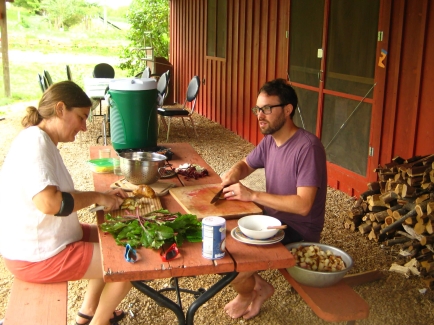
img_6168.jpg

David and Brenna cook at St. Isidore Catholic Worker Farm

Here are some of the reasons why:

1. The Meta Reason

If you zoom out, it is possible to see intentional community as a little solution to the BIG problems of our society. It can be the antithesis of capitalism, materialism, sexism, racism and violence. When we rely more on one another, learn to share our resources, and reconcile with one another we are creating the alternative society, offering a lived antidote to the ills of our American Capitalist Empire. We are creating a space where it is easier to be good to one another and the land.

2. The Practical Reason

Farming is a lot of work. Boy howdy! It is joyful work when it is shared with others, but tedious when done alone. It is also expensive. So sharing income, tools, and vehicles will be necessary for us: we don’t want to move to the country just to spend all our time making money in the city. We want our livelihood to come from the land, thus our time must be given to the land.

Community will also facilitate our ability to host visitors, interns, volunteers and homeless guests. And likewise we will be able to give one another breaks from the farm when we need to retreat, visit family, or attend a protest.

3. The Personal Reason

Community is a place of on-going spiritual formation. In my nine years at the Bloomington Catholic Worker, I have learned what it means to forgive, to be generous, to be humble and courageous. I sing with others, I eat with others, I pray with others. My children have playmates and they too are nourished by an alternative culture that emphasizes generosity, sharing, care for the poor, and conflict resolution. Intentional community helps me and my children be healthy and whole.


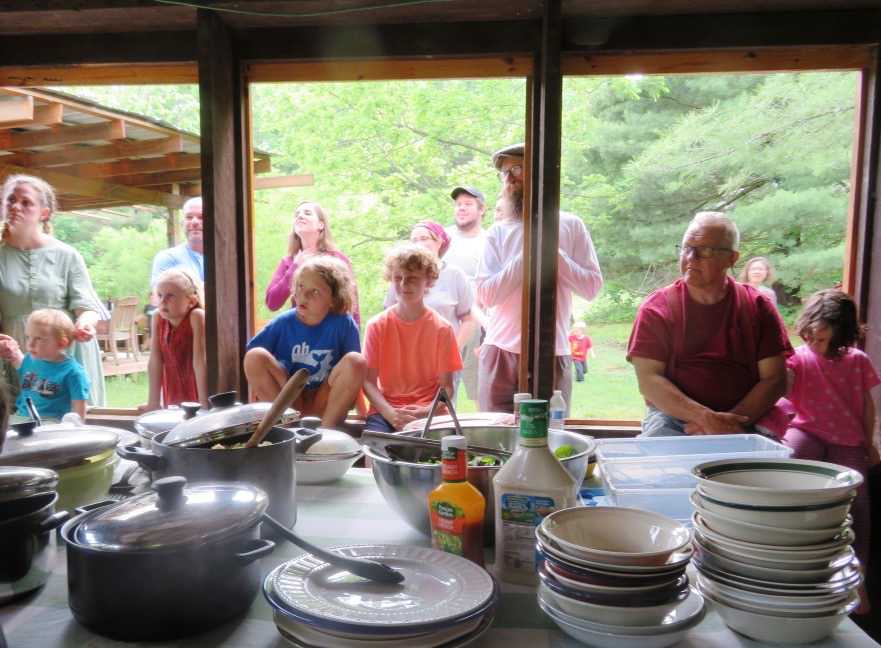
Lunch is ready at the Ohio River Valley gathering

Lunch is served at the Ohio River Valley Intentional Communities Gathering.


The Way In to Change

The Way In

Sometimes the way to milk and honey is through the body.
Sometimes the way in is a song.
But there are three ways in the world: dangerous, wounding,
and beauty.
To enter stone, be water.
To rise through hard earth, be plant
desiring sunlight, believing in water.
To enter fire, be dry.
To enter life, be food.

Linda Hogan

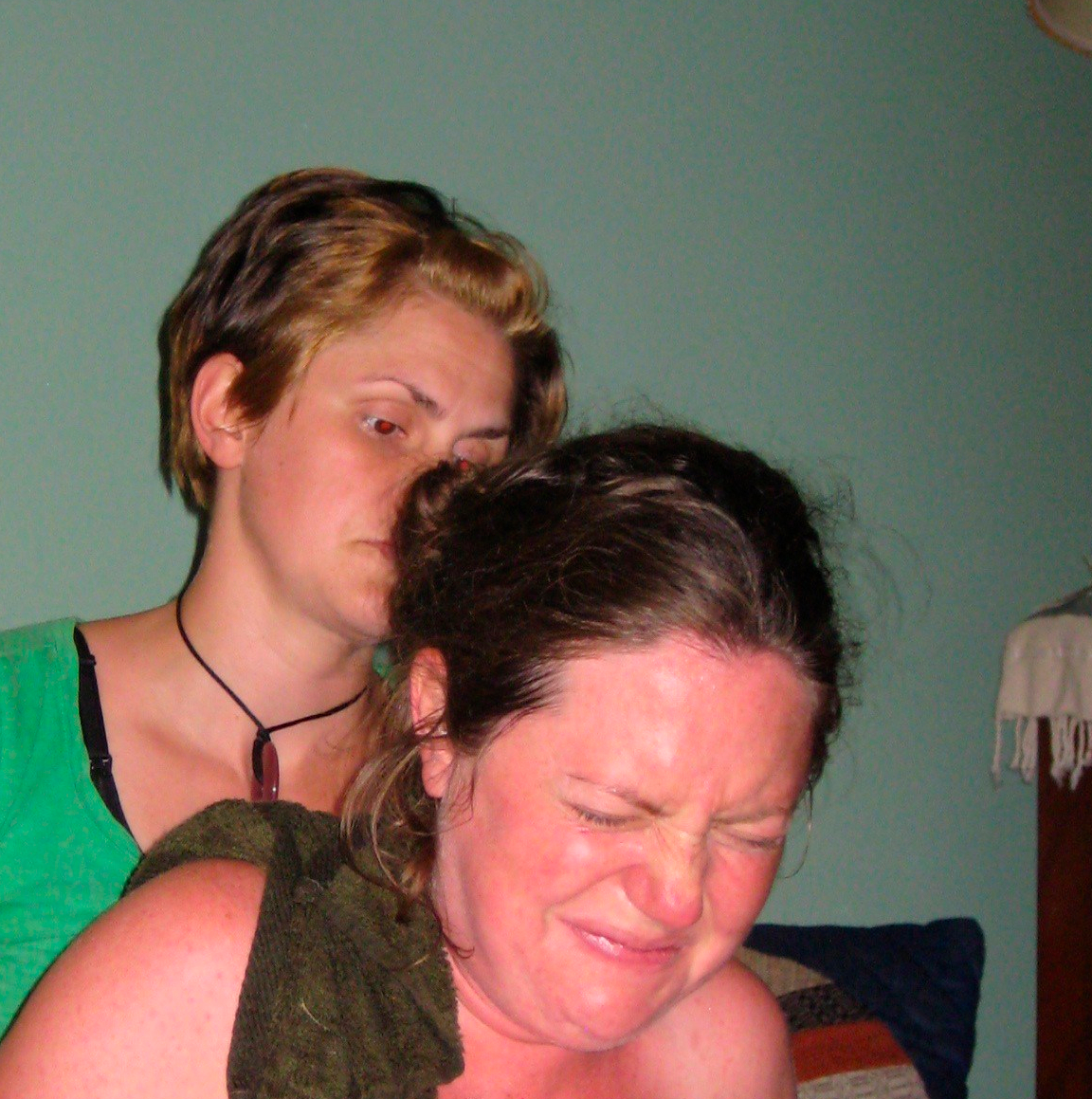
A year ago, standing in this yellow kitchen, leaning on the sink to wash dishes, I thought of childbirth. “We need to be born,” I said to David. “But how the hell is that going to happen?” We had a vision but couldn’t understand how to IMG_9531begin, which is to say, how to leave.

How do you choose childbirth – with the pounding back labor, the vomit-inducing contractions, and the fire-searing pain of the crowning? With the first child, you are gifted ignorance to endure the pain. And with the second, though you know exactly how much to dread the pain, you can also see clearly to the joy.

I am not ignorant to the pain of this change. Unlike childbirth, it afflicts me like a chronic condition. And I can’t see clearly to the joy because there so many questions: Who will join our community? How will we raise enough money? What land will be buy? Will we have to build a house? It is better when these questions wait patiently so that I can deal with what is at hand: Do we have enough boxes for our stuff? Will our children miss the community as much as I will? beautiful-blooming-bright-1165039

I am looking for the way in to change. I am finding it in poetry and in song. I am finding it in silent prayer, in the Psalms, in giant sunflowers. “To rise through hard earth, be plant / desiring sunlight / believing in water.”